
Bushid-Oh No
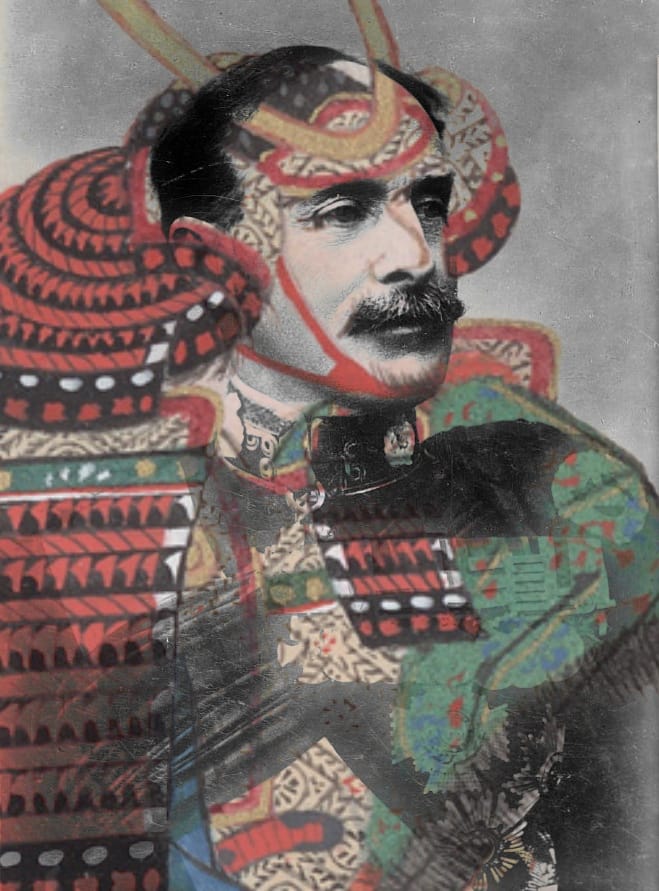
If you were active on the internet last year, you probably encountered the “controversy” over Assassin's Creed Shadows, the fourteenth installment of Ubisoft’s series of open-world stabbing simulators. The games explore various historical periods through the premise of an ancient secret war between the Order of Assassins and the Knights Templar. (Also, aliens are involved somehow.) It has not, in other words, ever been a series much concerned with “historical accuracy”, except in the most superficial terms. But you wouldn’t know that from the online tumult that erupted over the inclusion of Yasuke, the so-called “Black Samurai”, as a character. Fans raged that it was disrespectful to real historical figures and that it insulted Japanese culture, fought over the interpretation of fragmentary textual records to see if Yasuke was really a samurai or not, and of course, viciously attacked the historians associated with his story.
It's a strange line to draw, given that this is a franchise that famously allowed you to fistfight the pope, and which made it impossible to kill Anglo-Saxon monks as a Viking raider. But, of course, the sanctity of history is not why we’re discussing this. Like so many other controversies over “wokeness” (or DEI or CRT or political correctness, or whichever shibboleth we’re getting outraged about this month) the real crime is suggesting that you, the audience, could identify with a character different from yourself. And it is not a coincidence that it was Assassin’s Creed Shadows that particularly enraged these people, rather than other games in the series that intentionally give you the option of playing female characters in traditionally masculine roles.
The key to understanding the blow-up is recognizing the unique role that Japan plays in the anti-woke intellectual ecosystem. There's just something about the archipelago that deeply appeals to a certain sort of reactionary mind. It might seem, at first glance, like that's a necessary consequence of Japan's flood of cultural output: consider the figure of the "weeabu," people who have marinated themselves so deeply in anime and Japanese mass culture that they have ended up thoroughly sozzled. Yet as returning guest Nathan Goldwag explains, the roots of the right-wing affection for Japan go back a lot further than you'd think, and reflect much more on their own preocupations than the country they're seemingly obsessed with.
It's Heat Death. Stay with us.
Nathan here. In March 1904, the British General Sir Ian Hamilton arrived in Tokyo, eager to witness what was sure to be a revolutionary and titanic struggle for the future of the Asian continent. A month before, the Imperial Japanese Navy had launched a surprise attack on the Russian fleet base at Port Arthur. Now millions of men were being mobilized for a war to decide which empire would rule Korea and Manchuria. Hamilton himself was an experienced soldier, an epitome of the Victorian Age of conflicts: He’d spent his career on the frontier, fighting in India, Burma, the Sudan, and both Boer Wars. He’d come to Tokyo as a military attaché from the British War Office, with instructions to observe the Imperial Japanese Army in action.
It was a tremendously important assignment. Though none knew yet how close the onset of the First World War was, everyone in Europe was bracing for another Great Power war, and saw the clash between Russia and Japan—fought with machine-guns, steam-powered battleships, wireless telegraphs, and recoilless artillery—as a test run for the inevitable denouement of a century of political and military maneuverings.
But Hamilton did not see his role merely as a cataloguer of technical details, or as an observer of tactics. He had a broader mission in mind, and hopes of a grander conclusion, one that would impact all of Western Civilization. Because like so many other Westerners first come to the Home Islands, Hamilton had fallen in love with Japan—or at least an idea of it. And like so many other weebs — a slang term for those who have made Japanese culture their defining personality trait — the general did not merely admire Japanese civilization and society, he saw it as a mirror, reflecting what he failed to see in his own.
As was common in the dawning years of the 20th century, Hamilton was consumed with anxiety about the tumultuous state of Europe. A mixture of rapid technological change, social revolutions, political chaos—between 1890 and 1901 anarchists had assassinated the President of France, Prime Minister of Spain, King of Italy, Empress of Austria-Hungary, and President of the United States—all conspired to make men of a certain sort feel increasingly adrift. A veteran of the colonial frontier, Hamilton’s own worries, unsurprisingly, focused on Britain’s far-flung empire, and what he saw as the growing threat to it from within.
It was because of my conviction that up-to-date civilization is becoming less and less capable of conforming to those antique standards of military virtue, and that the hour is at hand when the modern world must begin to modify its ideals, or prepare to go down before some more natural, less complex and nervous types……city-bred dollar hunters are becoming less and less capable of coping with such adversaries.
Western civilization must enlighten its eventual conquerors as Rome even dying enlightened the barbarians, lest when our modern world is finally defeated in the field Europe should be wrapped again in darkness. Is it not the old, old story? India is Gaul, Central Asia is Germany; Varus loses his legions at Maiwand.”
Ian Hamilton, A Staff Officer’s Scrap-Book During the Russo-Japanese War, pgs. 5, 6-7.
In his conviction that the old “marital martial values” of Europe were waning, that civilization was sapping his people of what had allowed them to build their empires, and that the “primitive races” beyond the frontier were becoming an existential threat, Hamilton echoed the zeitgeist of his time. Like Oswald Spengler and Madison Grant, the authors of The Decline of the West and The Passing of The Great Race, he obsessed over genealogies and phenotypes and bloodlines, worrying about decadence and decay and whether the modern inheritors of Western Civilization could maintain the work of their ancestors. (If this sounds familiar, you’ve probably seen it before, especially if you’ve spent any amount of time on reactionary social media.)
But where Hamilton’s work becomes interesting is his solution: what we might call Japanism.
In Imperial Japan, Hamilton saw a way forward for Great Britain and the powers of Western Europe, “that glorious and impressive survival from heroic times, a nation in arms” (Scrap-Book, .v) that combined technological education and skill with the values and virtues of their martial past. The general waxes rhapsodic about this at great length, painting a picture of a heroic and united people, drawn from myth and folklore, united by their race and creed, and sworn to a pure cause.
For our allies are warlike by taste and tradition; and upon the patriotism, which they have absorbed with their mothers’ milk, their government has been careful to graft initiative, quickness, and intelligence.
In Japan the average citizen thinks, with the full acquiescence of his fellows, that under the Emperor he and all others are practically equal.
Ian Hamilton, A Staff Officer’s Scrap-Book During the Russo-Japanese War, pgs. 10-11, 37
From the military sphere, Hamilton turned his eye to the civilian, and quickly summed up gender relations and the role of women in Japanese society.
Men have always been selfish, but now an appalling danger confronts civilization in the shape of the American selfish woman and her imitators in Europe. In Japan, the sphere of the sexes is still totally distinct; and although this may shock foreign feminine opinion, in practice it certainly seems to tend to the general happiness. Not only to the general happiness, but also to the general military efficiency. Women occupied in passing examinations, struggling through society, sport, plays, travel, with interludes of flirtation, can scarcely find the time the Japanese mother does to stir the young imagination of her children with tales of derring-do.
Ian Hamilton, A Staff Officer’s Scrap-Book During the Russo-Japanese War, pg. 17
It will probably not surprise you to learn that Hamilton’s analysis of Japan was profoundly simplistic, papering over a complex and rapidly-evolving society with a patina of racial categorization and cliché. His impression, of a nation united in service and bound by tradition, fails utterly to capture the reality of Late Meiji Japan, which was undergoing the same sorts of massive political and social shifts as Europe was. The overthrow of the Tokugawa Shogunate in 1868 had brought to power a cabal determined to modernize Japan. The following decades would witness a monumental overhaul of traditional Japanese society as the government pushed rapid industrialization and scrapped traditional caste systems and relationships in favor of European-style meritocracy and efficiency. The samurai class was abolished and stripped of their privileges; the domains of the daimyō nationalized; a professional conscript army raised and equipped to win Japan a place on the world stage.
The Russo-Japanese War would prove to be an inflection point, as the power of the oligarchy of the Genrō waned in favor of new political parties. 1906 would see the selection of Saionji Kinmochi as Prime Minister, the first Japanese Head of Government to draw his support from a parliamentary majority rather than the emperor and his privy council. The Hibiya Park riots of 1905 were a major warning sign of the growing power of the ultra-nationalists. Later in 1906, the Japan Socialist Party would be founded—only to be banned a year later, with one of its founders, the anarchist Kōtoku Shūsui, executed in 1911.
But Hamilton was not really writing about Japan, a country he knew almost nothing about. Much as the light operatists Gilbert and Sullivan had done with their own Victorian foray into Japanomania in The Mikado, Hamilton was actually writing about his homeland of Great Britain and his own anxieties around the social upheaval of 20th century Europe. For a man who’d spent his career watching British power erode on the frontiers. Japan was a mirror in which he could conjure up a vision of the Britain he wished to see. He is, frankly, quite explicit about this.
In my presumptuous opinion, the Japanese are just as civilized as would be the Black Prince and his army if, by some miracle, they could now be resuscitated and have a thorough good German education grafted on to their unformed, medieval minds.
In America, as is well known, each man regards himself as a bit better than his neighbor; and the lower down the social scale you go, the stronger is this feeling, until, when you reach the car conductor or hotel clerk you find the most uncompromising type of despot the world has ever known……….In England, we have, socially speaking, no individuals. The population is marked off into petrified social castes, amongst which the financier plays Brahmin--the private soldier, Pariah. We have race pride, but it is almost swallowed up by caste pride. On the whole, of these three attitudes towards mankind in general and mankind in particular, I think I prefer that of the Japanese. An autocratic government with a genuinely democratic society is better than a democratic government with a society divided into strata, each autocratic to its inferiors and servile to its superiors, as in England, or servile to its inferiors and autocratic to its superiors, as in America.
Ian Hamilton, A Staff Officer’s Scrap-Book During the Russo-Japanese War, pgs. 16, 38
Europe in 1904-1905 was a continent embroiled in rapid shifts in culture and norms that left men like Hamilton feeling increasingly adrift and afraid. They would not have many reasons to find the following years much happier. In The Vertigo Years: Change and Culture in the West, 1900-1914, author Philipp Blom diagnoses a “crisis of masculinity”, driven by industrialization, mechanization, atomization, feminism; the world was changing, and people no longer knew their place, or what was expected of them. Hamilton was in Japan to observe a facet of this, a world-revolutionary event: an Asian power going to war against a European one and, for the first time in modern history, decisively defeating it.
In Hamilton’s paeans to Japanese society and culture, you can see him constructing a mythology to soothe his own nerves: an imaginary society where there is no social strife, where the complexities of the modern world can still be managed by the dead hand of tradition, while still maintaining its conveniences.
Given the anxieties and terror of our own era, we should not be surprised to find men still searching for a mythical past, and still using Japan as the object of their veneration. In the same way that Sir Ian Hamilton looked upon the Empire of Japan as a throwback, an atavistic version of Britain without the flaws and compromises inherent in the modern society he knew, so too do many modern reactionaries seem to view the islands of the Rising Sun as a land untouched by the diversity and complexities of our own homelands.
There is a certain logic to this; people may complain bitterly about modern media being “political” or “woke”, but it is hard to ignore the fact that Black people and LGBT people and so on exist in America today. Despise them or not, you will see them going about their business in many parts of the country. And for those who hate living in a generally rather cosmopolitan society, there is the Japan of the imagination: a comfortably distant exemplar of uncorrupted “traditional” culture. Hamilton could imagine Japan without the class conflict and bureaucratic infighting he saw at home in Great Britain. Today, Twitter trolls and various other reactionary online denizens can imagine it as a place without diversity. In both cases, the “Japan” under discussion is not a real place, it’s merely a projection of anxieties and aspirations. The imagined uniformity is a comfort, in a world that can often be confusing and scary. The fact that this hypothetical racial and cultural purity is not ours, does not encompass most of the people praising it, seems less important than the fact that it — ostensibly — exists. It is a theoretical construct to idolize, not a community to belong to; a rhetorical cudgel to wield in the Xbox Live chat rather than a sincere expression of principle.
Of course, the real Japan — a nation full of flesh and blood people, in all their contradictions and diversity of thought — often fails to conform to the version they’d constructed. Reactionaries do not often take reminders of this well. When, for example, a non-binary person is included in a visual novel or an anime ends with two girls going on a date, fans insist it must be a mistranslation or changes from woke Western editors. (In reality, of course, this process has often happened in reverse. Witness the famous Americanized dubs of Sailor Moon, where Sailor Neptune and Sailor Uranus went from being lesbians to “cousins”, due to censorship demands.)
One of the stranger manifestations of this sort of controversy was the backlash in 2022 when the character Bridget in the game Guilty Gear Strive was described as a transwoman. In past iterations of the Guilty Gear franchise, she had been presented as a man raised as a woman for complicated plot reasons. The recontextualization of the character, therefore, was met by various posters proclaiming that this was a misunderstanding of Japanese culture, or a mistranslation. It was accused of being “femboy erasure”-- a term sometimes used to describe the online cultural conflict between feminine or cross-dressing men and transwomen--and compared to colonization. People cited the descriptions on Japanese porn sites to “prove” that Daisuke Ishiwatari (the creator of Guilty Gear) was mistranslating or misunderstanding the Japanese terms. It was all very stupid, but unintentionally quite revealing. While being a “femboy” isn’t inherently right-wing (and boy, there’s a sentence I never thought I’d write), it’s impossible not to notice that some people clearly liked the fantasy of indulging in femininity and genderbending, but were furious at the implication that it could have “real” implications. Paradoxically, there does not seem to be a contradiction between these obsessions and being dedicated to racial and sexual purity. They want to indulge in the transgression of the fetish, without being reminded of the complexity or complications of actual human beings.
It is impossible not to note the layers of abstraction here; anime characters are fetishized for performing to the standards of an idealized Japanese culture that is, itself, entirely manufactured. Actual Japanese people here are no different than characters in a video game or a visual novel, with fans responding to choices they disapprove with the type of entitlement we’ve all become accustomed to.
(That the reactionaries of 1905 worried about martial values and military efficiency, and their descendants today complain about video game characters and femboy representation is perhaps a commentary of sorts all on its own—but perhaps I am merely falling into the trap that I critique here.)
For both Sir Ian Hamilton and the reactionary weeaboos of the modern internet, Japan served as a sort of liminal space, a mysterious land on the far side of the world that you could project your fantasies of a pure, untouched culture on. We’re in our own crisis of masculinity right now, and our conceptions of gender roles are shifting rapidly, the old certainties eroding out from under our feet. American geopolitical power is waning, new power centers are rising, the onward march of demographics are shifting the very definition of our country as we watch. The Americans of tomorrow will not be the same as the Americans of yesterday, or even today.
But East Asia has, in no way, escaped this insecurity. If anything, Japan and South Korea are Ground Zero for the current fight over women’s equality. In Korea, birth and marriage rates plummet, while 80% of Korean women say that “gender conflict” is a major issue. We can grapple with that and try to find a new way to live with each other in all our glorious diversity—or we can retreat to an imagined redout, a vision of an uncorrupted utopia, free of wokeness or political conflict. It little matters that both Hamilton’s visions of martial virtue and democratic autocracy and modern anti-woke tradecath aesthetics are both, themselves, products of a globalized flattening of culture and society into memes and vibes, because the goals have little to do with anything actually historical or traditional. They are about fear. Fear of the future, and fear of the unknown.
Hamilton was not wrong when he grimly warned that “Asia and Africa were not even now stirring uneasily in their sleep, and dreaming dim dreams of conquest and war”. (Scrapbook, pg. 12) The world was changing, and that can be a terrifying thing to witness. The temptation is always there, to retreat, to construct an imagined vision of past stability, and wrap yourself in its comforting embrace. But it won’t help. The Japan that reactionaries imagine never existed, and never will, and all we can do is meet the world where it is, and as it is.
As Hamilton himself wrote, at the Battle of Liaoyang: "I have seen today the most stupendous spectacle it is possible for the mortal brain to conceive – Asia advancing, Europe falling back, the wall of mist and the writing thereon."
Nate Goldwag has written for Mondoweiss , the Journal of Cartoon Overanalyzations and Liberal Currents. You can find him chatting about science fiction, history, and other esoteric topics at his blog, Goldwag's Journal on Civilization, and over on Bluesky at @goldwagnathan.bsky.social.
This has been Heat Death. We're entirely reader-supported independent media. If you like what we do here, feel free to subscribe: paid memberships are just $2 to $5 a month, and the money goes to support writing like this. (Or you can always leave us a tip.)
While we're growing, the single most helpful thing you can do is send it to someone you think will like it or post it on your favorite social with a nice note. We are, above all, a word-of-mouth operation.
Until next time – we probably don't have to tell you this, but maybe try to be normal about Japan.




Member discussion