
On The Proper Order Of Kings
Asher here. I've been very busy in the trenches of my forthcoming history of Texas paleontology (only four chapters left before the first draft is finished!) and have thus been spending a lot of time in the archives of University of Texas' Vertebrate Paleontology Lab, digging around in the voluminous correspondence of dead paleontologists. Such excavations occasionally yield the kind of gold nuggets you can't really put in a book, but really feel like you have to share somewhere. And very often, such glittering finds have come from the collections of one John A. "Black Jack" Wilson.
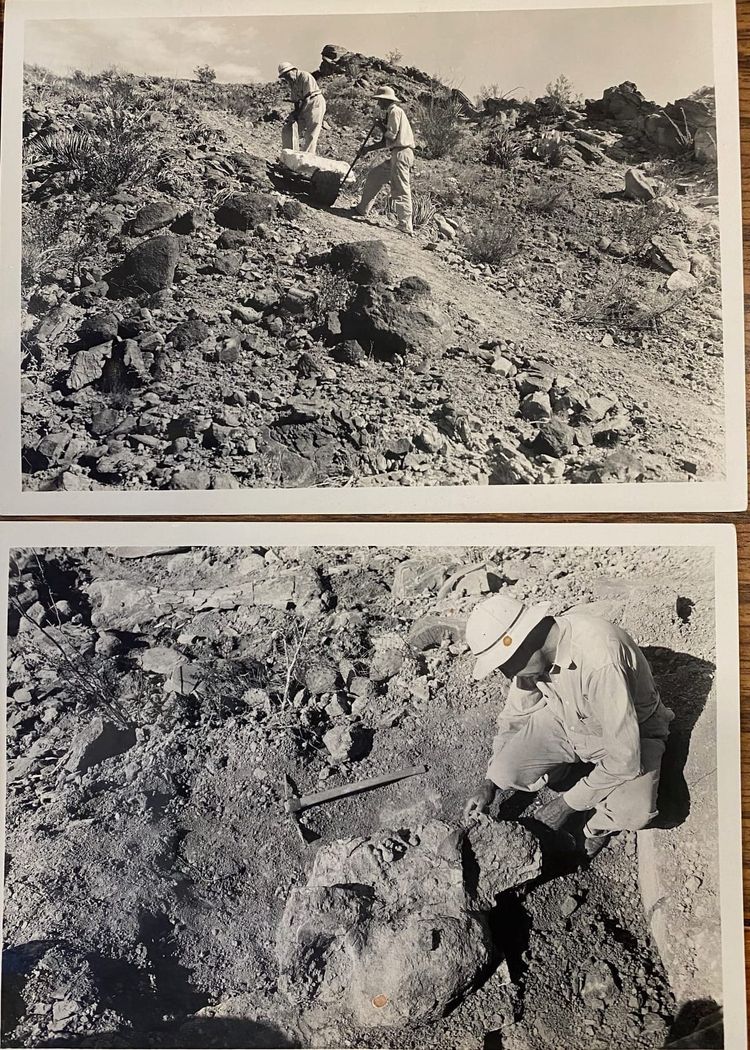
Wilson is a big figure in Texas paleontology, largely because he was the one who managed to wind through the thorn thickets of university bureacracy, personal feuds and general inertia to gather together the scattered state fossil collections of Texas and make a single home for them. Mostly, though, what interested Wilson were the various dynasties of ancient mammals that arose after the Cretaceous extinction. Prior to his death in 2008, he spent much of his career in West Texas, trekking over ludicrously unfriendly and rugged terrain in the summer heat to collect giant camels, fork-horned horse relatives, false sabertooths, hell hippos, and bug-eyed little primates. Yet his interest wasn't primarily the animals themselves. Wilson was mostly interested in how animal communities change over time, which necessarily meant spending a lot of time thinking about stratigraphy – the quest to establish a clear chronological order of different rock strata – and periods of geological time.
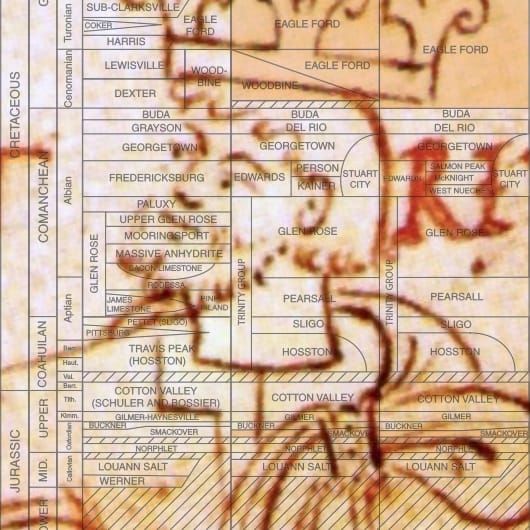
Units like the Cretaceous or Carboniferous, or the Permian and Pleistocene have a practical use: they exist to try and give everyone a common language for describing certain sets of time. They are very familiar. Somewhat less familiar are the various smaller subunits you can split something like the Cretaceous into: the early part of the period might contain little periods of a few million years, like the Aptian and Albian. These, in turn, are often split into further stages: the Comanchean, say, which includes a specific order of rock layers like the Paluxy, Fredricksburg, and Georgetown. These extremely distinct units are all well and good when you're trying to work out the flow of time in one location. When you're trying to match up the flow of time in different locations, though, things get considerably trickier. How do you know whether or not a rock layer in Texas and one in New York are of the same age? Dating isn't always possible. Many times, paleontologists find themselves looking at fossils to try and make layers match: if you find the same sort of animals in the same rock layers, presumably they're fairly close in time.
There's a issue here, of course: animals have different ranges in time and space. (Jaguars persist in Central America, for example, but have not been present in the United States for over a hundred years. Depending on who you ask, horses also spent thousands of years absent from the Americas: now they're back.) So correlating animal remains across time is, itself, a very tricky business. Lineages can persist in some places for longer than others, and with an incomplete fossil record, it's often tricky to tell. And this isn't touching the extremely vexed question of how to reliably distinguish a fossil species to begin with.
And thus we have a generalized problem: in order to talk about standard units of time, we customarily group rock layers according to whatever original rock layer someone gave the name to. (The Jurassic, for example, is named after the Jura mountains of the Alps; the Permian after old Perm, Russia. That's because of where they were originally described.) And the animal populations are slippery, because it's not always clear whether something is absent in terms of time or simply for reasons of shifting habitat and geography. What appears at first glance like a nice, neatly rigid order of geological events on a chart begins to look decidedly shaky the more data you have, and the closer you examine it.
Wilson was more than aware of this. "That order could be made of the stratigraphic section and of the multitudinous variety of fossils has never been doubted by stratigraphers and paleontologists," he observed in a public lecture. "It was and still is, in itself, a tremendous act of faith which we have more or less unconsciously accepted. With the scientists of the last century this faith was perhaps stronger and more certain. They proposed numerous laws, often gave them fancy Greek names, and believed these laws to be of world-wide application. With a small amount of data such interpretations could reasonably be made, and perhaps many of the so-called laws would have stood up if the amount of data had remained small. Unfortunately, a great deal more data have been accumulated since the so-called laws were proposed and one by one they have been demoted." And yet in stratigraphy, Wilson noted, people have tended to cling stubbornly to old certainties and old orders, which is part of the reason why he wryly "[placed] stratigraphy to the conservative reactionary right,” rather than a more "leftish" understanding of animal ecoystems as in constant flux.
Indeed, Wilson's frustration with typical stratigraphic thinking led him to pen a nicely arch bit of satire, which I found in his papers. It's not clear to me that this was ever published, or whether he simply delivered it as a lecture somewhere. But it's the sort of thing we love here: a sidelong look at how a scientific intellectual tradition functions, delivered with an extremely deadpan and very academic sense of humor.
This is Heat Death. Take it away, Jack.
Let us imagine a historical science called Rulerology. Its subscience, kingology, is defined as a study of the succession of Kings of England, because the science was started there. Remember, please, that this is king-ology, because the word king comes from the old Anglo-Saxon, cyng. The study is applied only to males; all queens are by definition excluded. So too, are any usurpers who were not of some royal blood or other. (My apologies to my British friends, I can’t use the presidents of the U. S. because they have all been both male and president.) The kingologists early recognized that a king ruled for a length of time and set up a timescale based on their succession.
The custom of having the kings name and likeness, but unfortunately no dates, on the wooden coins of the realm enabled kingologists to correlate excavated cite with excavated site. Because the sun never sets on the Empire, these wooden coins are widespread. With the advent of C114 dating, a technique, which works well on wood, the time of the beginning and end of each era was accurately established. It pointed up hiatuses at the beginning or end of each era and firmly established the presence of a hiatus near the middle of the Stuartic Era. A catastrophe was known to have occurred at the end of Charlesonethian time but the duration of the time of removal was previously unknown. Even though the C114 [Carbon dating – Asher] techniques were known to be able to date wooden coins as young as 5 years, suspicions were confirmed that we were really living in a kingological hiatus, because none younger than 1952, bearing the likeness of a king, could be dated.
Some young upstart kingologist suggested that hiatuses could be filled. He proposed the following names for the hiatuses in order from present to past: Elizabethtwothian, Victorian, Annian, Marytwothian, Cromwellian (subdivided into Richardcromwellian and Olivercromwellian), Elizabethonethian and Maryonethian. He reasoned that, although these were spans of time that reflected either nondeposition of kings or removal of kings, events that consumed time were actually going on in England as evidenced by gold coins with likenesses of queens and pewter coins with men with strange hats, obviously not royal.
The Fellows scoffed. For one thing the upstart had proposed etymologically unacceptable terms; Victorian, Annian and Cromwellian didn’t end in -thian as did all the rest. Secondly, theirs was a science of kingology, the word having come from the old Anglo-Saxon, cyng; nothing but kings could, by definition, be included in the succession.
To solve the dilema, which was recognized as such, it was agreed that the only solution was to plug the hiatuses with borrowed kings. A venturous Fellow had journeyed to the continent and discovered in Denmark wooden coins with the likeness and name of a king and so he proposed that the Present epoch, beginning in 1947 (dated by C114) be Frederikninethian and that it extend up until today. True there was some evidence of overlap but this seemed a good safety factor and anyway an international committee could settle it all by deciding exactly when Frederikninethian time began.
Committees were appointed with Youknowho [We have no idea who this refers to, making it – somewhat appropriately, given the subject matter – a fossilized beef. – Asher] as chairman to fill the other hiatuses with kings. The long hiatus from 1837–1901 was filled with Russian Czars:
* Nicholastwothian
* Alexanderthreethian
* Alexandertwothian
* Nicholasonethian
Proper language allowance was made for the transliteration of king to czar.
A French king was found to fill the hiatus from 1689–1714: Louisfourteenthian. Alexisithian, another Czar, satisfactorily filled the hiatus in the Stuartic Era; and finally, the last committee report recommended that Philipthreethian, Philiptwothian and Charlesonethian, all good Spanish Kings, fill the earliest hiatus. Thus grew the standard kingologic time scale. It was accepted as the standard of comparison for the world.
Some short-lived suspicions were aroused in other continents. Whether the suspicions grewfrom an inherent suspicion of kings or kingologists is not known but for a while a revolutionary movement was underway to have a local chronology based on governors of New York. This was beaten down by the English founding fathers of the science. Later a governor of Missouri (from the Ozarks) with a
period called Ozarkian and a governor of Canada (from Nova Scotia) and a period called Acadian, and even a whole tribe of Indians and period called Comanche, were proposed but lost for lack of a second.
It is pointed out in the Code of Kingologic Nomenclature that kings are material things and that the science of kingology can deal only with material things. Time-kingologic units depend fundamentally for definition on an actual king or successions of kings and without these standards they are meaningless. Each time-kingologic unit is the record of an interval of time that extended from the crowning to the death of the king. As time-kingologic units depend for definition on actual kings (or coins, both are material), care should be taken to define kingologic time units (which are immaterial) in terms of time-kingologic units and not vice-versa.
To quote further and most important: “Ideally the boundaries time kingologic units, as extended geographically from the standard succession, are isochronus surfaces (all parallel to the heads of the coins), representing everywhere the same horizon in time; thus ideally these boundaries are independent of Presidents, Queens, Chiefs, Fuehrers, Duces or even Military Juntas.”
Kingology can be so linear.
This has been Heat Death. We're entirely reader-supported independent media. If you like what we do here, feel free to subscribe: paid memberships are just $2 to $5 a month, and the money goes to support writing like this. (Or you can always leave us a tip.)
Till next time, remember:




Member discussion