
The Sermon Under The Mount
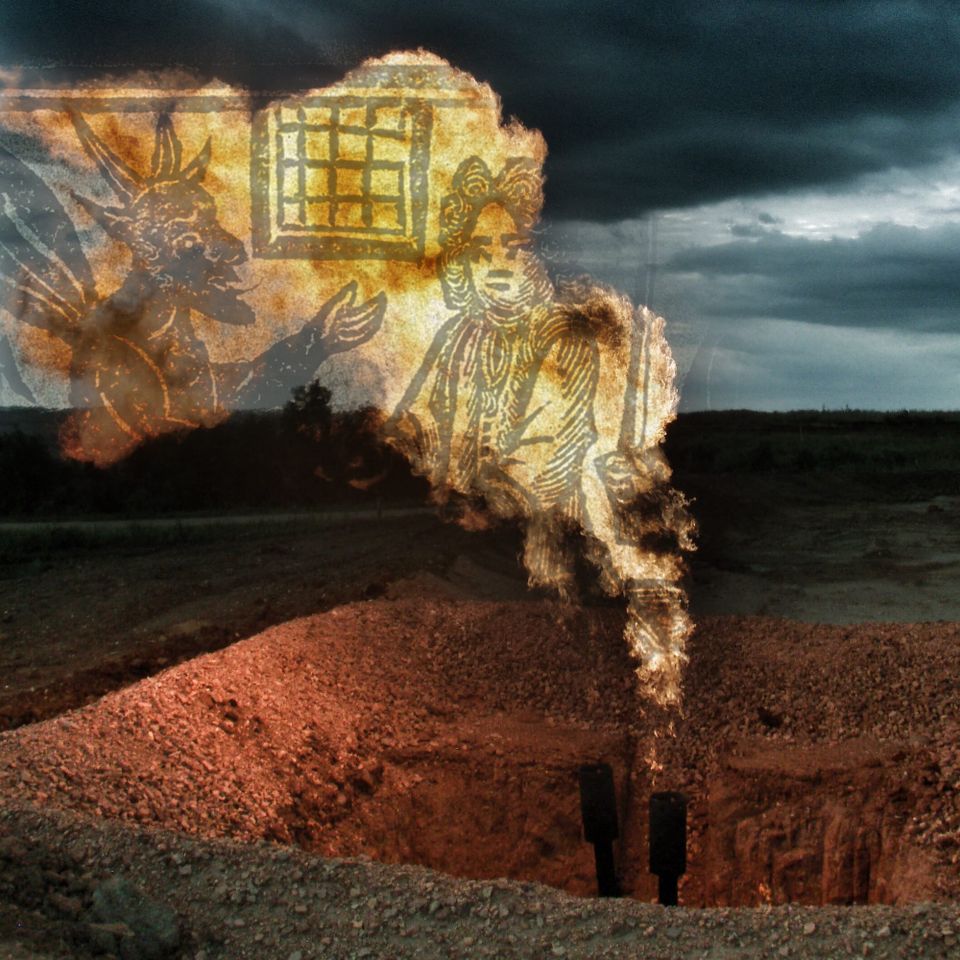
Saul here. There are some stories that have about them a sense of cosmic horror — a thing appears on the landscape and begins to grow, warping life around it. If you're fond of pulp fiction, you might know the sort I'm talking about: a meteor pollutes a backcountry farm with indescribably colours out of space. Alien wreckage creates a Zone that is not to be entered, except by the desperate. A strange vail shrouds an area of swampland, shifting and recombining all that lives inside.
These are fictional examples, of course. But real world examples abound. Consider the drilling rigs that sprout like mushrooms on the doorsteps of suburban homes. Or the backhoes that open vast pits to receive oilfield waste. Trucks dump PFAS-rich sludge on farmland as fertilizer. Plastic plants shed truckloads of tiny pellets in every storm. Poisoned water geysers from injection wells as the very ground fills up with fracking fluid.
And around every city in Texas, data centers rise like temples to the coming of the machine god — their runoff potentially rich and putrid with nitrates.
Zoom out and the map of Texas — the map of America — has, over my lifetime, become a pointillist experiment in quantum poisoning. Around each dot, you can picture families complaining of strange and hard-to-pin-down ailments: headaches, nausea, dizziness, confusion, anxiety. Fish die. Horses sicken. Cattle drool and keel over. Sperm counts fall; rare cancers proliferate.
Is any of this connected? Is all of this connected? Outlook seems uncertain; studies are being done; there is no way to quite tell. In the meantime, drill, baby! Drill. Jobs, baby, jobs! If we lose the race for Artificial General Intelligence, we’ll all be speaking Chinese. And if we win? Everywhere, now, people mutter dark jokes about whether any of us will have jobs at all. Storms break across our cities unlike any seen in my lifetime, swollen fat on the carbon belched from tailpipes and smokestacks. The breadbaskets are drying out. The populated coasts are growing deadly.
And not only is there no force on Earth that seems able to stop it — there is no shared vision of what stopping it might look like. The foundations put out white papers; the technocrats meet, and meet, and meet; we all quietly go insane inside our houses, convinced we are the only ones freaking out in a world that seems determined to ignore the disorder creeping every outward from the holes in the earth.
But — what if we weren’t?
This is Heat Death, the newsletter that knows the danger of accepting tasty gifts from dapper creatures. I’m writing to you from Austin with some major news: I left The Hill in October to start a new initiative to connect the disparate Texas land-and-water fights — and the creators and influencers who publicize them — to each other, and to the broader global struggle to secure a livable future.
The timing was in part professional: something I have been building came to fruition at just the right time. But it's also personal: my second son, Cyrus, was born in August. I look into his clear eyes, sparkling with an infant's delight — and I see the darkness coming that I cannot save him from, as I cannot save myself, as you cannot save yourselves.
At least, not alone.
That initiative is called Future Heist, and I’ll have more to say about it in the new year. But for now, here’s a little something ripped from my notebook: an attempt to find a way to tell the story of our current moment in a different register.
Not as science writing or technical explanation — but, perhaps, as our children and grandchildren will wish we had told it. Imagine it thundered from a camp meeting in the mid-2030s, as part of the new Great Awakening, to a crowd of the dispossessed, as stormheads loom and roil above the tent.
Just Say No (To the Fire from Below)
We all know the story of the Devil: how he lives underground, in a place of smoke and fire. How he comes to Earth bearing promises and gifts. How he always delivers what he promises: wealth, power, fine things. But we also know how all his gifts turn into ash. That, in the end he takes back far more than what he offered.
Or at least, we’re supposed to.
In the 1990s, the age of oil seemed to be ending. The easily accessible lakes of oil that once lay beneath the state of Texas were long gone; the oil majors like Exxon who had made their fortunes off them had long since abandoned the country for empires abroad.
But the oil that we suck up and burn in cars and airplanes and ships comes from somewhere even more ancient: the ruined worlds miles down. Down in the deep, in those sunless realms, former versions of Earth lie crushed and pulverized by the planet’s weight, their bodies squeezed out and mixed, over unthinkable time, into a solid mixture of rock, gas and oil. Geologists call this the “source rock,” the place all oil and gas come from. And it’s where — geologists had long believed — it had been locked away, impenetrable, forever.
That’s how it could have stayed. In the 1990s, as windmills sprouted across Texas. The first solar farms — based on technology invented in America, but surrendered to the Chinese — began to harvest the sun. The nuclear engineers who had built the great plants that still buttress the grid today were still in the industry.
But that’s not what happened. Because a group of Texas oilmen figured out how to punch down into the mother rock and break it open, releasing the oil and gas within. In doing so, they made themselves almost unfathomably rich. And they decided to remake the U.S., and the planet, in their image.
Some might argue they deserved that right. The oil and gas they released let the U.S. play empire in Europe and Asia. It allowed Detroit to bring back the era of gas burning muscle cars; gave Americans cheap vacations overseas. It was made into plastics for a new flood of consumer goods, and pesticides and fertilizers that let American agriculture get bigger and more consolidated than ever. It powered the new data centers that allowed social life to move from outside to online, and the cloud computing that allowed the rise of smartphones, and the AI models that allowed companies to do more with fewer people. And credit where credit is due: the power from underground delivered wonders.
But wonders were not all it delivered.
Even before fracking was invented, its creators — the new class of rich men we’ll call the Underworld Kings — had poisoned water supplies in North Texas; now these zones spread across large swaths of America, a country that once prided itself on the boast that you could drink the water wherever you went.
And that poison spread throughout the nation, and the world. Those new plastics broke into tiny pieces that copied our bodies’ own messaging, spreading sickness and cancer in a thousand insidious ways. The fertilizers and pesticides gave their workers cancer as much as cigarettes, and they fostered a kind of farming that only the biggest companies could do. That meant more corn and processed food, less fruits and vegetables. Less diversified farming that could withstand storms and pandemics; more feedlots dumping cities worth of shit into streams.
And, in a matter of speaking, more shit into our bodies. Year by year, as those oil-based materials became more prevalent in the economy, more and more young people have turned up with cancer. And every year, as more microplastics showed up in the testicles, male fertility has dropped.
And even that was not enough. The gas they pumped was too cheap to sell, so they dumped it unburnt into the atmosphere, speeding up planetary heating from gradual to breakneck. And with gas so cheap, the market for alternatives collapsed.
But perhaps the biggest thing it did was drive us all crazy. The cloud computing revolution that created Facebook and Twitter depended on the flood of cheap gas. Gas powered “the attention economy,” which made men like Mark Zuckerberg rich off the ability to hook us on piddling bullshit, and to keep us engaged by elevating the worst impulses of human nature.
And in the most literal way, it funded the Christian nationalists who want to make sure that the State of Texas makes sure you’re in their kind of Church on Sunday, and that your kids grow up believing in their kind of Jesus.
The amount of oil and gas produced, year after year — and the money in the pockets of the Underworld Kings — just goes up. The Underworld Kings got their man — Donald Trump a man who made it big in the new gas-powered attention economy — back in the White House. They want to produce ever more oil, more gas, more plastic, more pesticides, more fertilizers — more and more, forever, sucking up the last of the money while they plan their own escapes to places like New Zealand and leave the rest of us in the wreckage that remains.
Perhaps they can’t help it. Perhaps what they touched underground changed the way they thought. Perhaps it set them on fire, and they're burning still: setting everything they touch alight. Perhaps, when you’ve been tricked by the Devil, you can’t always tell.
In our system, a company can’t walk away from the profits oil generates, or its shareholders can sue them. So they pour — the must pour — their money and their resources to fighting against the move toward a future where everyone can have a decent life.
That’s why it falls to the rest of us — for their own good, and for ours — to rein them in. To bind them with laws to keep them from biting out their own tongues. To not look at the kingdoms of this world being offered us. To keep our eyes lifted, instead, to the next, which is the one we will leave our children.
To say, as was said so long ago:
Get behind me, Satan.
This has been Heat Death. We're entirely reader-supported independent media. If you like what we do here, feel free to subscribe: paid memberships are just $2 to $5 a month, and the money goes to support writing like this. (Or you can always leave us a tip.)
Also, to reup this request: We are putting together an essay collection that combines the best things we've published, and we'd love your submissions! Send us an email here with the stories you'd like to see in print. Put "Heat Death" in the subject line.
We'll be back soon with more musings on past, future, and all the crises in between. See you on the other side.



Member discussion