
Wars of the Worlds
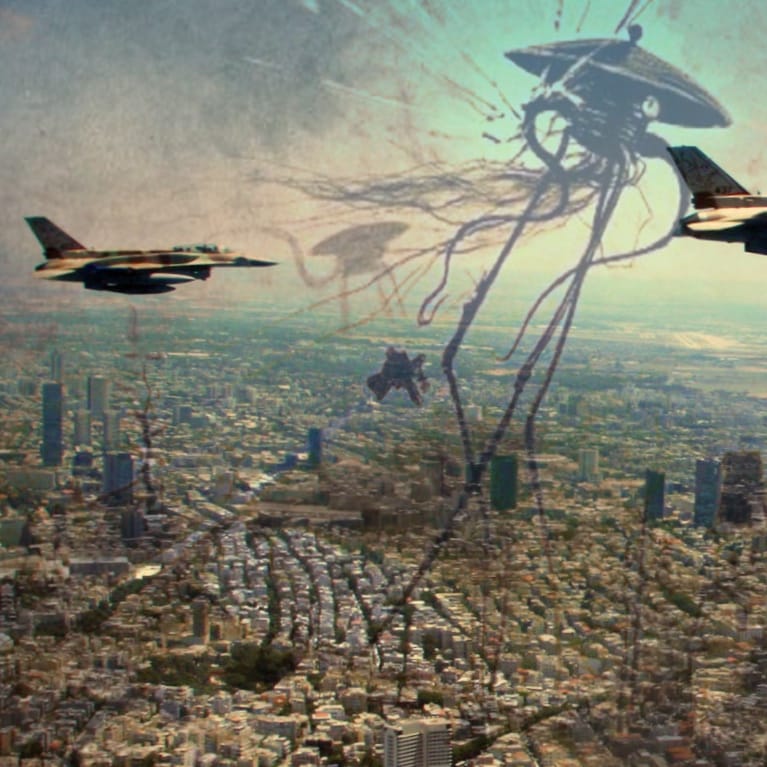
Outer space, as Asher has often observed, is often fantasy of colonization. We will leave the crowded old world in imperfect ships, make dangerous voyages in search of new lands on which to build and reshape to our will. These lands will, of course, be empty, terra nullius, to do with as we see fit. We will change their atmosphere, strip them of their resources, and use them to fuel our way out to the next world, and the next. What's the frontier there for, if not to be tamed? What is emptiness for, if not to be filled? We call it space because that’s what it offers: endless room for us to roam, and for our children to roam. It is mankind’s destiny to go among the stars.
And yet there are stories of what happens when the stars come to us. Of vast ships appearing out of nowhere in our skies, bearing technology we cannot match, opening us to their designs like a knife blade opens an oyster. Of metal leviathans sliding through the soundless void between creation, each a predator nation consuming everything in its path. Of cold-eyed things that look at us and see nothing sapient, nothing alive, who perform horrors upon us and call it science, who take our men or our women, who use us like beasts, who kill us in pursuit of their own relentless expansion. The final frontier, remember, is endless. Or even, if you like, hungry.
Welcome to Heat Death, the newsletter that knows we were the real aliens all along. Today we're welcoming returning writer J.D Harlock, last seen in this parish discussing the origins of robots. This time, J.D's been thinking a lot about one of the absolute classic setups of science fiction: the alien invasion as presented in War of the Worlds. It's a text that can be hard to see through its many, many, many imitators and adaptations. But it's somewhat less straightforward – and sadly a lot more relevant – and you might remember. H.G Wells' tale of attempted intersteller conquest has a lot more to do with Earth than it does space, and how humans treat their planet comes under direct scrutiny.
It's Heat Death. Stay with us.
J.D here. I’m writing this from Beirut, a city that has been devastated by imperial ambitions for generations. There are no signs this will change any time soon. As airstrikes rain across the sky above me, I’m experiencing that devastation firsthand and not for the first time. This is why I’ve been revisiting some of the anti-imperial texts that have inspired me over the years with new eyes. It helps, in some ways, to reckon with the surrounding tragedy: both by understanding the stark realities that fuel it, and recognizing how little seems to have changed the endless expansion of “empire” even in the post-colonial era.
None of the texts I’ve been reading lately have resonated with me, however, as much as The War of the Worlds.
H. G. Wells’ The War of the Worlds is a science fiction novella first serialised in Pearson's Magazine in April 1897, before being published in full in 1898. It concerns an attempted invasion of Earth by advanced beings from Mars (i.e, the Martians) after their planet has become uninhabitable. Though not as widely read as it once was, it’s essentially the literary example of the conflict between humankind and an extraterrestrial race in popular culture, with endless adaptations, sequels, prequels, parodies, pastiches, and homages churned out every other year around the world. (Americans might know it best as the subject of an Orson Welles radio show that accidentally inspired a mass panic, or the inspiration for a Tom Cruise-starring War on Terror blockbuster.) Its influence on popular culture cannot be denied: if you’ve seen, heard, or read an alien invasion story, you’ve seen the shadow of War of the Worlds.
In the years since its publication, The War of the Worlds has been variously interpreted as a commentary on the theory of evolution or a critique of human self-satisfaction. Others have read it as a reflection of Victorian-era fears, superstitions, and prejudices. Mostly, people have landed on it being an allegory of colonialism: a depiction of Great Britain—a technologically advanced, militaristic civilization that casually sweeps other species and societies out of existence to feed its own expansion—receiving the same horrific treatment it had been delivering to the natives of its empire.
Wells was indeed uncannily ahead of his time in the ways he chose to depict the intricacies of colonization’s horrors, one missing from most modern portrayals of that era. But its critique of colonial expansion via the Martians’ inhumane treatment of Earth’s indigenous population in the British Empire is just the beginning. What truly sets War of the Worlds apart from other anti-imperialist texts is its focus on how an empire’s advances in science and technology are leveraged for ecological destruction as well as ethnic cleansing in order to further their ceaseless expansion. Wells was one of the few who seemed to have understood that scientific progress, imperial expansion, and ecological destruction are inextricably intertwined within the history of market capitalism, and that such an unholy alliance must eventually be the downfall of human civilization. The War of the Worlds thus stands as one of the most astute anti-imperialist texts ever written, and has a lot to tell us about the shameful period in human history.
The War of the Worlds opens with an unnamed British narrator visiting an observatory to be shown explosions on Mars's surface. Afterwards, what initially looks like a meteor lands close to his house in Surrey. In fact, it’s a spacecraft. The first of the Martians emerges from its spacecraft, setting up strange machinery that incinerates all the humans who approach it. Soon, the Martians bring proper war machines to bear: towering tripod-legged machines armed with “heat rays” and a poisonous black smoke that quickly defeats the British armed forces. Fierce resistance by those armed forces only manages to take down three of their tripods before the Martian reinforcements land. At the same time, a fast-growing “red weed” the Martians have brought over spreads across the countryside, choking the rivers, smothering native plant life and recoloring the environment with a red hue. Human survivors try to develop plans for a resistance— but it clearly has no prospect of success. The narrator wanders through the devastation near another Martian landing site, where he stumbles across the aliens drinking human blood for sustenance.
Alas, Great Britain—the “apex-”[predator] of human civilization—has been easily defeated. Yet strangely, the victorious aliens are soon nowhere to be found. Finally, upon returning to London, the narrator learns that all the Martians have died from bacteria because they lacked immunity to Earth's microbes.
On a first read, The War of the World seems like exactly the same sort of standard alien invasion story as its legions of imitators. Yet to grasp what Welles is doing, his novella has to be situated within the existing literary tradition that it emerged from: invasion literature.
Proto-invasion fiction first appeared soon after the French developed the hot air balloon, with French and American poems and plays centering —rather wishfully — on balloon armies invading the United Kingdom. However, it wasn’t until the shock of the Franco-Prussian War (1870–71), in which Prussia and its German allies used rapid rail mobilization and modern breech-loading weaponry to defeat France, that fears of invasion by a technologically superior enemy became politically urgent in Britain. George Tomkyns Chesney's The Battle of Dorking, published in Blackwood's Magazine in 1871, quickly translated these anxieties into fiction, depicting a surprise German attack on the south coast of England. Chesney’s story won widespread popular acclaim. It was reprinted a month later as a pamphlet, which sold eighty thousand copies and, in the process, launched the British genre of invasion literature, which would last in the mainstream for decades. Wells himself would take several stabs at it, including his own 1907 story The War in the Air.
Notably, there’s a basic plot similarity between The War of the Worlds and The Battle of Dorking: both books feature merciless enemies that make a surprise attack on the British armed forces that, in both cases, are incapable of stopping their relentless advance — leading to the decimation of southern England’s Home Counties. However, The War of the Worlds diverges from The Battle of Dorking in one telling way: the twist ending. This is one of the few aspects of the plot remembered in popular culture — aside from the basic premise and its depiction of aliens and their advanced technologies — generally because of “the alien invaders all die from Earth’s bacteria” seems to come out of left field.
But disease and colonialism have a very long history together. Wells was writing amid the “Scramble for Africa” of the late 19th century, a stampede of European colonial projects across the continent which had begun twenty years before War of the Worlds was published. Early European colonizers regularly came into contact with unfamiliar — they might have said “alien” — peoples, and regularly contracted virulent diseases from a habitat that they seemed particularly ill-suited to. Africa came to be known as the “White Man’s Grave.” Europeans were generally unable to enter the continental interior at all until medical advances — like the wide availability of anti-malarials like quinine — made their colonialization efforts possible. Even so, diseases spread in both directions with severe consequences, and epidemics were invariably intertwined with the other hurdles faced during colonial expansion.
The colonialism parallels extend to the way Wells depicted the Martians themselves. At one point, we are informed that the Martians have enslaved a second alien race, bringing three individuals along like livestock in cylinders to drain their blood for consumption. One of the supporting characters — a soldier simply referred to as the Artilleryman — predicts this as humanity’s likely fate once the aliens take over. Like the European colonisers, in other words, Martians seem to have achieved their military prowess at the cost of complete reliance on their victims. As a result, they are constantly desperate to move on from areas they can never inhabit sustainably. To make the parallels more obvious, the narrator even theorizes that the Martians may have evolved from human-like ancestors:
“There is many a true word written in jest, and here in the Martians we have beyond dispute the actual accomplishment of such a suppression of the animal side of the organism by the intelligence. To me it is quite credible that the Martians may be descended from beings not unlike ourselves, by a gradual development of brain and hands (the latter giving rise to the two bunches of delicate tentacles at last) at the expense of the rest of the body. Without the body the brain would, of course, become a mere selfish intelligence, without any of the emotional substratum of the human being.”
At one point, the Artilleryman predicts that the Martians will recruit certain humans once they've finished conquering the Earth, allowing them to steady their hold on the planet by keeping other humans in check. These recruits will specifically be former priests and politicians, who will receive special privileges and local influence in exchange for propagandizing in favor of Martian supremacy. At the same time — he hopes — the Martians will offer former soldiers the chance to serve as their auxiliary troops. This is a direct mirror of how Europe's colonial powers extended and maintained their influence over their colonies by offering similar rewards to local chieftains, aristocrats, and warriors in exchange for their allegiance.
Wells was, at the very least, open about it having a sociopolitical angle. "My early, profound and lifelong admiration for [Jonathan] Swift...is particularly evident in a predisposition to make the stories reflect upon contemporary political and social discussions," he wrote in the preface to his collected works in 1933. Elaborating further, he wrote: "The War of the Worlds like The Time Machine was another assault on human self-satisfaction" with both later stated to be "consciously grim, under the influence of Swift's tradition."
Wells drew further inspiration for the plot from the catastrophic effect of European colonisation on the Aboriginal Tasmanians, which had only ended in 1832, and referenced it directly in the first chapter, "The Eve of the War:” "And before we judge them [the Martians] too harshly, we must remember what ruthless and utter destruction our own species has wrought, not only upon animals, such as the vanished Bison and the Dodo, but upon its own "inferior" races. The Tasmanians, in spite of their human likeness, were entirely swept out of existence in a war of extermination waged by European immigrants in the space of fifty years. Are we such apostles of mercy as to complain if the Martians warred in the same spirit?"
Not everyone agrees that anti-colonialism is the best lens, however: some argue that Wells was actually trying to critique ecological destruction instead. In this reading, the Martians are a stand-in for humans, and we, in turn, are a stand-in for the animals we’ve hunted to extinction. Revisiting The War of the Worlds with this reading in mind, I realized that the narrator of the novella does frequently make that comparison, suggesting that the Martians regard humanity no differently from how we tend to regard common vermin. To the invaders, we are not just pests to be exterminated or cattle to be consumed: the narration explicitly compares humans to rabbits whose warren has been destroyed by homebuilders. We and our environmental needs are beneath notice, to be cleared casually out of the way. The red weed, for example, one of the plants that were brought over by the Martians, is introduced to our environment for reasons unknown, but with this reading, it can be explained be away as one of the instruments of their terraforming efforts for Earth, to make it more habitable (or simply more comfortable) to them at the expense of our own habitability in our own ecosystem.
By the end of the epilogue, the narrator surmises that the Martians witnessing this from Mars must have learned a lesson in humility, because humanity was able to dominate Earth's harsh ecosystem only after millennia of struggle and setbacks, and no species could have achieved the same without similar perseverance. This is why one of the great ironies of The War of the Worlds, Wells suggests, is that humans have developed a newfound empathy for wild animals after the alien invasion, as they now understand what it's like to be hunted — or exterminated. The narrator’s brother even rejects characterizing the events as a war at all. arguing that "It never was a war,” he argues, “ any more than there’s war between men and ants.” Nor can humans," and states that humans shouldn't judge the Martians, he muses, since humans have done the same to other animals, and even to other humans.
Welles draws the point home with the novel’s conclusion. Humanity, despite its domination of the Earth, quickly falls before the Martians'scientific and technological might, Wells implies, because the British imperialists have forgotten that they’re still subject to the natural world. Ironically, so have the Martians: they believe, hubristically, that their technological power has made them exempt from the rules of nature. This is why they ultimately lose, their nonexistent immune systems leaving them defenseless against Earth's microorganisms. Ultimately, our survival is tied to the extent of our harmony with our ecology, and that harmony can be taken away from us by callous invasive species.
This is a more ambiguous ending than it initially seems. As The War of the Worlds comes to a close, the narrator admits that humanity's win is likely to be short-lived, as it won’t stop more Martians from coming to Earth and learning from their predecessors. (Quite a lot of Europeans died, you will recall, before quinine unlocked the African interior.) At the same time, humans have salvaged Martian technology to learn from it, and have even unlocked the “secrets of flight.” Worse yet, the narrator argues that as planets age, they become cooler and drier, and that Earth will eventually experience the same, forcing humans to move to Venus, which the Martians have been theorized to have successfully conquered in this round of the “war.” The implication, along with the narrator’s musings on the Martians’ potential ancestral similarity to us, is a troubling one: that they are not just our potential oppressors, but our potential future.
Here it becomes clearer what Wells is doing: painting a picture not just of a savagely genocidal colonial expansion, but one that also takes the form of widespread ecological destruction. That real imperial powers viewed the "other" humans as animalistic groups to be exterminated is well established. But Wells seems to be commenting on the way imperial powers ravaged the environments they invaded for their industrial "progress" and market expansion, reshaping them to fit their own economic needs as the reed weed seemed to have done to Great Britain. Wells was far ahead of his time in advocating for ecological conservation, even as prominent biologists of the era didn’t show much interest in it.
From the analogies he’s drawn in his text, it seems that Wells saw the history of colonial capitalism and ecological destruction as intertwined, a heartbreakingly prescient message for the mid-1890s. It wasn’t until after the 1970s that the study of colonial impacts on the environment became a recognized academic field. Previously, colonialists have used “declinist” narratives, painting colonized landscapes as fragile and mismanaged by the indigenous populations, and using that “mismanagement” as a pretext to seize more land under the guise of “protecting” the environment. All the while, the environmental devastation native peoples experienced was driven almost entirely by the colonial powers’ ceaseless resource extraction, overhunting, deforestation, and industrialization. Wells was one of the few who caught on to this, critiquing its utter callousness alongside the horrific extermination of the indigenous population.
War of the Worlds, therefore, isn’t just an anti-colonial or an environmentalist text: it works because it’s both. Indeed, in its treatment of the Martians as analogues for British colonialists, I can’t help but notice an often-overlooked throughline in the novel’s various elements — the genocidal violence, ecological destruction, and the imperial logic behind them. All are driven by the relentless pursuit of advanced, but short-term solutions, by an extremely intelligent and adaptable species. At the same time, the science and technology necessary to create the Martian war machines’ force fields and skeleton beams are light-years ahead of our human understanding, and it’s what gives them the edge at the start of the “war.” They adapt quickly to setbacks after initially underestimating human resistance. It’s made crystal clear that the Martians don't harbor any particular malice toward humanity; their need for blood as a resource supersedes any empathy they may have in this situation. This, combined with the relentless drive that allowed them to dominate their environments with scientific prowess, has made them conquerors.
Yet it has also dragged them into a self-defeating cycle, sucking the life out of every environment they enter until they’re forced to find somewhere else to exploit. Earth could never have been a home for them long-term, even if they had conquered it: eventually they would have used it up, and had to leave, and begun the whole cycle all over again. By the end of the novella, I think it’s made painfully clear that the Martians with this determination could have come up with a “humane” — that is, long-term and sustainable — solution to their resource scarcity and associated ecological problems, rather than the more short-term solution of invading and sacking the Earth. Cold intellect, as Wells notes, could have been tempered with empathy. Their failings, in other words, are the imperialists’ failings: unfathomably complex knowledge, put to the task of smash-and-grab operations, of salting the ground beneath their feet rather than making it bloom.
Of all the atrocities depicted in this novella, this is perhaps the most recognizable. In the end, it's also the hardest one to stomach.
J. D. Harlock is an Eisner Award-nominated American writer, researcher, editor, and academic pursuing a doctoral degree at the University of St. Andrews, whose writing has been featured in Strange Horizons, Nightmare Magazine, The Griffith Review, Queen’s Quarterly, and New York University's Library of Arabic Literature. You can find him on Bluesky, Facebook, Instagram, LinkedIn, & Twitter.
This has been Heat Death! This piece was supported by paid memberships to this newsletter. If you'd like to support us – and help us commission more work like this – please consider grabbing a subscription. Want to pitch us? Send ideas to aelbein@gmail.com.
We'll be back soon with more musings on past, future, and all the crises in between. Till next time, remember: We have met the Martian, and he is us.



Member discussion