
After The Deluge
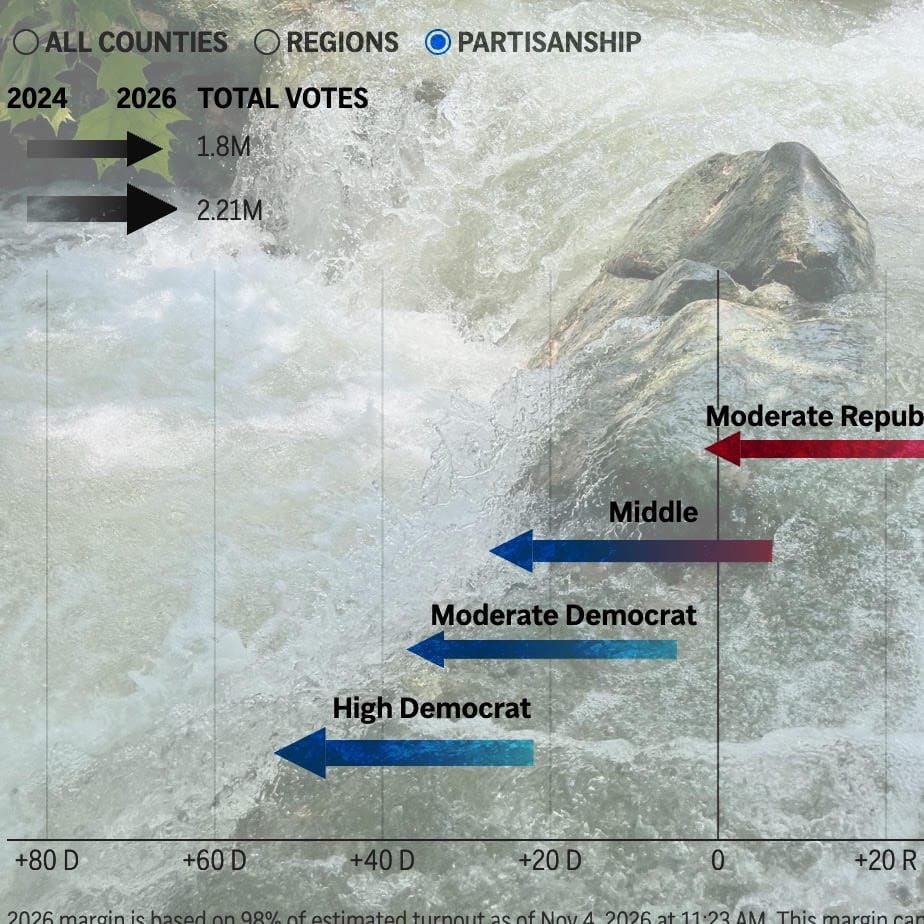
Saul here. Last night, around midnight, I heard a knock at my door, and it was Asher, my brother and Heat Death co-writer, looking like he was ready to levitate off the floor. “Do you have any whiskey?” he asked. He doesn’t drink. “We need to do a shot.”
I poured the bourbon. I should explain. On a certain November evening in 2016 that you may remember, he was visiting me and my then-girlfriend in Montreal. He fell asleep early and woke in the middle of the rout, and the three of us spent a frigid, ugly night watching the Clinton-Trump returns come in, feeling a greater darkness close around.
For us, as for many of you, that brutal memory was why it was hard to believe that what just happened was going to happen, even as the ground seemed to be shifting beneath our feet, even as it ultimately ended up producing a map that looked like this:
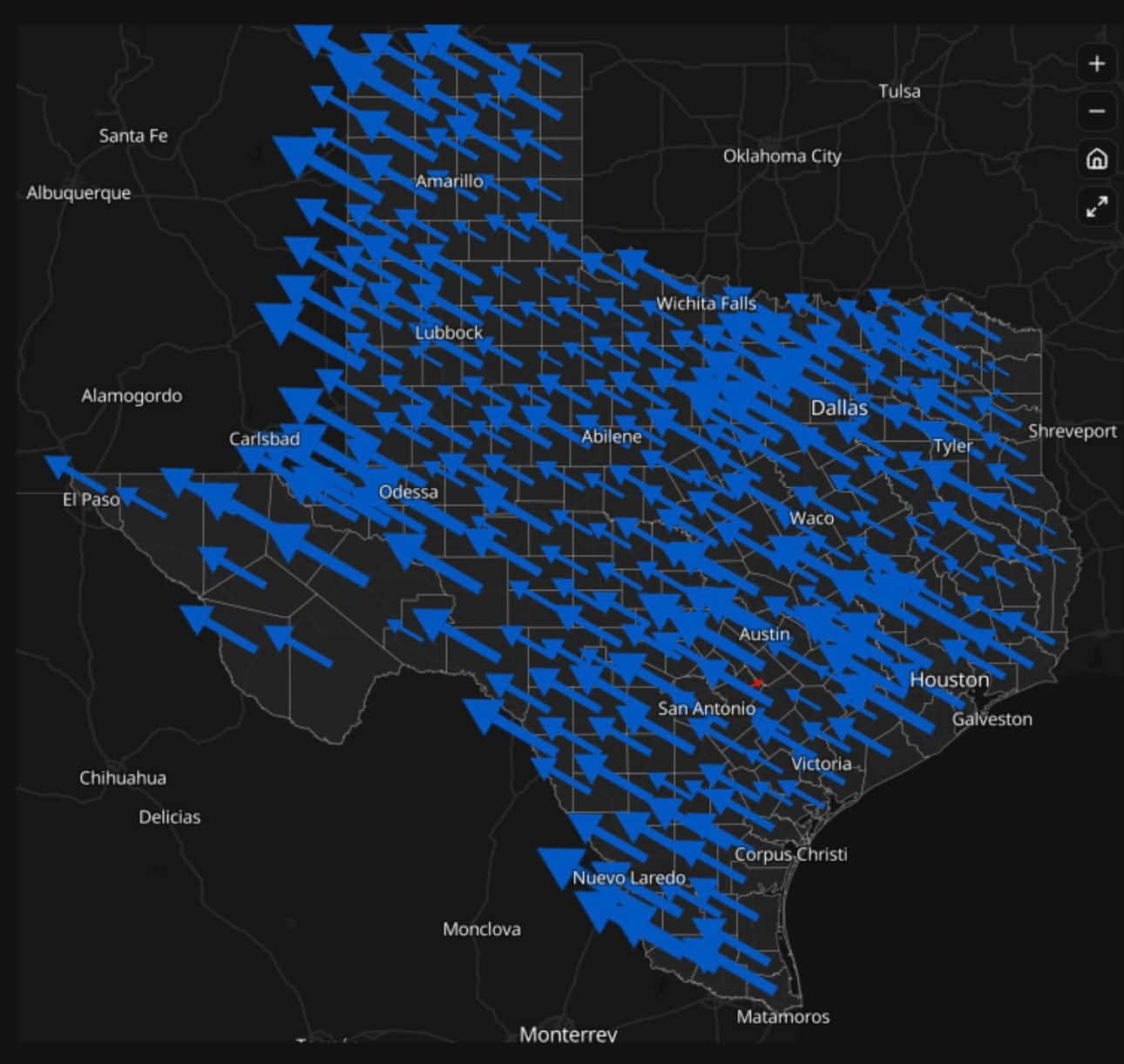
How so? Let us count the ways.
A statewide grassroots movement against data centers reared its head in cities across the state, uniting far left and right. Conservative ranchers sued over the Trump administration’s push to build a wall through the widely beloved Big Bend National Park under contracts that steered more than a billion dollars to a politically wired contractor and that a rival bidder is now in court calling rigged. So did liberal environmentalists. In October, a federal judge in El Paso stopped the bulldozers. Previously disengaged friends of mine with kids in the Austin public schools—a district targeted for takeover and likely destruction by the Abbott administration—were on fire for Gina Hinojosa, now the governor-elect. MAHA challenged Big Ag on cancer-causing pesticides.
Evangelical Republicans in the fracking-afflicted counties south of Fort Worth told me angrily about how Abbott had backed measures letting oil companies dump fracking wastewater on food—as well as shielding them from liability if anyone got hurt. Other Republicans organized around fossil fuel waste pits and land seizures for reservoirs and fights over water rights. Texas farmers were hammered by skyrocketing diesel and fertilizer prices from a confounding and unnecessary war in Iran. Ranchers—who had fought for decades, often alongside progressive groups, for the government to stop them from being priced out by cheap foreign beef—watched Trump blithely open America to Brazilian imports. Rural Texas counties, where public schools are the centers of the community, were torn and angry over a concerted effort by Abbott, Lt. Gov. Dan Patrick and the indicted, investigated and impeached Attorney General Ken Paxton to purge from the party every legislator who didn’t support the private-school vouchers their mega-donors backed.
And against this, what did Texas Republicans offer? Fealty, to Trump, of course. But also: Patrick launched a crusade against the state’s very successful and overwhelmingly popular weed industry. Abbott said he would pause data centers in August, and then their permits in September, and then, for weeks, just … didn’t. The Texas Railroad Commission, the state oil regulator, after months of residents showing up to complain about oilfield waste in their communities, voted to strip public comment from its meetings. The attorney general and the General Land Office—which objected to bulldozing on a single tract of its own and said nothing about the state parks—rolled over and let the Trump administration bulldoze its way through some of the state’s most cherished state parks.
So when the election came, with no room to maneuver on data centers, and backed by a right-wing base grown utterly detached from reality, they ran on issues that were fundamentally trivial. I saw this at a TPUSA rally in Johnson County, where populist also-rans whipped up the crowd with the talking points that later became features of the Abbott, Paxton and Patrick campaigns. They raised the threat of “sharia law”—in practice, a halal-coded version of Joe Bob and Cletus, having fallen out over their shared barbecue joint, asking the minister to settle their dispute—and categorized it as something requiring a Protestant Reconquista of North Dallas. And when they could be bothered to talk about actual policy that might make a positive difference in someone’s life (as opposed to ruining a stranger’s day), it was stuff absolutely inimical to running a civilized modern society. Nothing works and prices are too high? Well, what if we got rid of property taxes?
This was theoretically perfect messaging for the hothouse of modern Texas politics: harnessed to a right-wing media machine hermetically sealed from the actual world, piped into a Texas Republican primary electorate that has been exquisitely gerrymandered over decades. And it worked great. Great, at least, if the goal was to wipe the Republican slate clean of reasonably trusted incumbents who had some relationship to their constituents.
That’s the other story of the race. For decades, remember, Texas was a Democratic stronghold. They lost it through the following pattern: successful incumbents left for Washington (Lyndon Johnson for the vice presidency in 1961, Lloyd Bentsen for the Treasury in 1993) while their appointed replacements were trounced by popular, hustling, hungry Republicans (John Tower, Kay Bailey Hutchison, respectively). After flipping the legislature, in 2003, the GOP managed to draw the state’s most powerful Democrats out of their districts, theoretically locking themselves into power.
This year, Republicans did it to themselves! Crafty political animal and Comptroller Glenn Hegar decamped to go further de-woke-ify Texas A&M. Attorney General Ken Paxton—having skated through his extremely popular impeachment in the House thanks to Patrick’s control of the Senate, and misreading his series of easy elections in a de facto one-party state for actual political skill and popularity—left his safe seat to run against John Cornyn for the Senate. At the same time, Republican primary voters threw out Cornyn, Agriculture Commissioner Sid Miller and Railroad Commission Chairman Jim Wright.
Put the two together—open seats at the top of the ticket, and a primary electorate that punishes anyone with a record—and what came out the other side was a general-election slate of newcomers and extremists whom most of Texas has never voted for and did not much like.
And in the general, what did Republicans do? They closed polling places anywhere they possibly could. They talked at great length about how James Talarico had said God was nonbinary and Hinojosa wanted to turn your kid trans, and a Tim Dunn-funded PAC texted voters that Democrats were (and I am not making this up, though I dearly wish it were true) being propelled to the polls by armies of furries. And then, of course, as state infrastructure crumbled, as schools failed and were taken over by a state education agency apparently opposed to the idea of public education, they promised more cuts to property taxes, which fund the schools and (at this point) basically everything else.
And the icing on the cake: the racism! Toward the close of the race, Bo French, the former Tarrant County party chair and failson who won the GOP runoff for Railroad Commission, posted—after the University of Texas football team beat Ohio State in a one-point comeback—a photo of South Asian students celebrating in Darrell K Royal Stadium. “The problem,” he wrote, “is now obviously far worse than anyone imagined.” And despite how happy they’d all been to make inroads with non-white voters in 2024, virtually no Republican in an active race pulled an endorsement—and instead, party leaders rallied behind him.
Amid all of this came stomping, stumping Donald Trump, telling everyone who would listen how great everything was going. The man went to Lubbock—whose city council in 2015 voted to make drillers keep twice as far from homes and businesses, and this September moved to halt data centers altogether—to tell everyone how he was deregulating the oil industry to make it easier for the smallest and shittiest operations to dump methane and associated pollutants into the air.
As the race entered its final month, Ken Paxton was asking supporters at a San Antonio rally to load their contacts into his campaign app, check each day whether their friends had voted, and tell the ones who hadn’t to vote Republican if “you want me to stop harassing you.” And Don Huffines—who would go on to be thrashed for comptroller despite Abbott making him the incumbent—was telling people to, for the love of God, please hold their noses and vote for Republicans, as he’d held his nose for Mitt Romney. (An argument possibly familiar to Democrats from 2024, and which proved about as effective.)
Paxton: I need you to download our app so you can put all of your contacts in and track your friends voting and you can remind them everyday: if you want me to stop harassing you, go vote Republican
— Acyn (@Acyn) October 7, 2026
Asher and I were both born in Texas, in the waning days of Democratic hegemony. That long era, and to some extent the George W. Bush and Rick Perry years that followed it, was marked by a particular sort of collegiality and rolled-up-sleeves practicality unique in the United States. As in: we’re all Texans here, by God, and we’re going to get this done. Build good schools, and transmission lines, and rational energy markets. Turn a blind eye toward undocumented immigration. Accept more refugees than any other state and settle them in our booming cities, to become proud barbecue-eating, U.T.-cheering Texans.
But for all of our adult lives, and particularly this last decade, Texas politics has been a masquerade of sneering, petty brutality and triviality that hides a rank assault on anything and everything that allows our society to continue, offered by a group of grasping opportunists whose main pitch has been that they are assholes, which is okay—good, even—because you are too. A group of people—like Paxton (North Dakota), Patrick (Maryland) and Chip Roy (also Maryland), beaten in May’s attorney general runoff—who, it feels fair to say, given that they are such utter nativists, mostly aren’t even fucking from here.
Which would have been perfectly fine, you know. Had they been at all willing to assimilate and learn our culture.
Maybe,the signs were everywhere. Or more to the point: not everywhere. In the month before the election, as Democrats organized at a fever pitch, we each traveled through rural Central Texas and saw a surprising number of Talarico and Hinojosa signs, and a noticeable absence of any for Abbott or Paxton. Earlier in the spring, Asher drove past a property on an east-bound highway out of the Hill Country, long marked with a Trump-emblazoned Cessna airplane in the front and a profusion of anti-Biden signs. This time its owner had kept the plane but put up a new sign on the reader board: “Idolizing a politician is like falling in love with a stripper.” Then there were the defections. Karl Rove, as close to a founding father as the modern Texas GOP has, announced in the Wall Street Journal that French’s post was “raw, uncut bigotry,” that “the GOP’s stables need a cleaning,” and that he would be voting for the Democrat. (What mostly gets cleaned out of a stable is, for our city readers, horseshit.) John Cornyn, four months after Paxton took his seat from him, called French “an embarrassment to the Republican Party” who would weigh down the whole ticket, and said he would not vote for him. Miller, the agriculture commissioner, a deep-red populist Republican, broke with state leaders over data centers, and did joint events with the Democrat he would have been running against, if not for the primary.
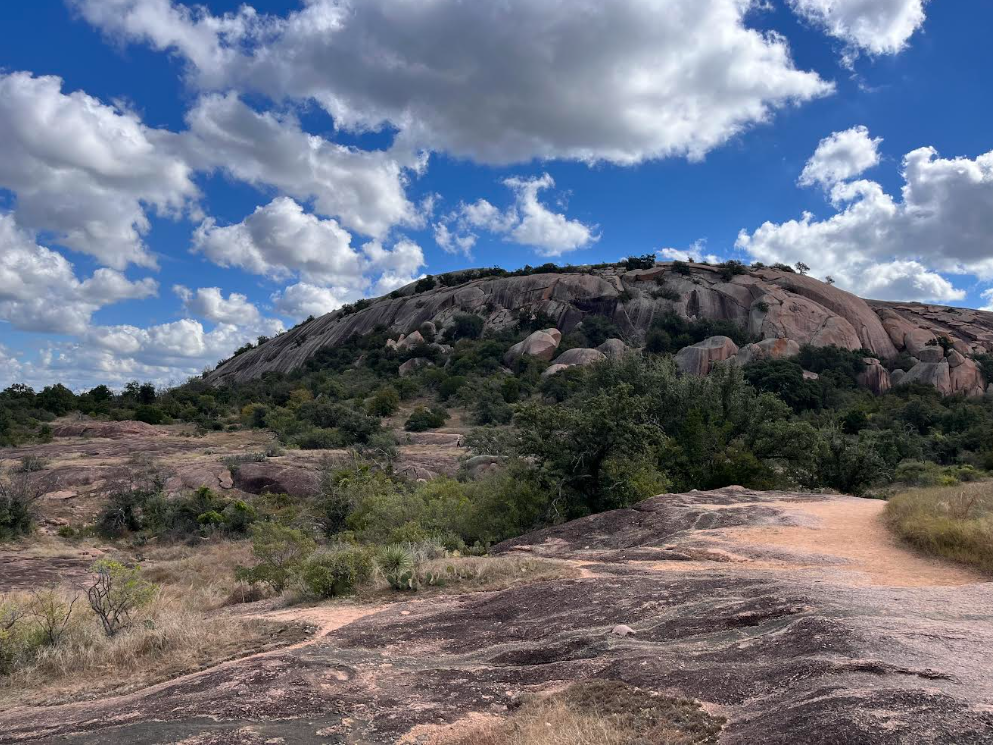
The weekend before Halloween, I drove out to Enchanted Rock, a vast granite dome, more than a billion years old, that rears from the limestone of Central Texas like a sleeping god. There is no place in Texas like it: a bit of the inner earth that has worked its way free of the layers deposited by the dance of inland seas across its surface, sloughing them off over slow eons to form the soil beneath the live oaks growing below.
It was a full moon. Some friends and I (in defiance of the park guards) hiked up onto the rock and listened to the sounds of the Hill Country spread out below us. In the pale moonlight, the rock was faintly lined with the rills where rain had washed crystals free of the granite to collect in little sheltered vernal pools. There, lichen broke them into smaller crystals, and together with the rain and wind worked them, eventually, into something mosses, grasses, ferns, brush and eventually even trees could root in. Trees whose roots sought deeper into the crevices of the rock, holding on against wind and rain, until the rock itself began to give, and gave way in great sheets to shatter below—a micro-scale recapitulation of the dawn of life on Earth. The sounds of that life filled the darkness below: coyotes howled and yipped to each other; a herd of cattle engaged in some extended bovine orgy. I saw the land of Texas, ancient and fragile and almost unbearably beautiful. And so terribly, terribly neglected.
When I got back to Austin the next day, Asher and I went climbing. We talked around the election, neither of us willing to say what we were both thinking. Finally, I did. “Gun to my head,” I said, “I think Hinojosa wins.”
Asher sucked his teeth. “Man’s got to take a stand,” he said. “But if she wins…”
We thought about the map. It sounded incredible, but the logic was inexorable. The smart money at that point was an Abbott-Talarico split, though that didn’t match what either of us was seeing, and what we thought we might smell on the wind.
But if Hinojosa won, then what of downballot? It was the strongest slate I’d seen in my lifetime—a collection of heavy hitters I’d mostly interviewed as a political journalist at The Hill and come away seriously impressed by. It seemed incredible to say that any of them would win. And yet, if Talarico. If Hinojosa. Then—
There is, in Central Texas, a clear and deeply felt precedent for this kind of thing. We live above karst that sucks up water as fast as it falls, in a drought that has lasted more or less my whole life and is only getting worse. At the same time, the region is punctuated by creeks and swimming holes that fill when it rains—places of both surpassing beauty and heartbreaking transience.
Some of these punctuate the ancient fault canyon along Barton Creek, a canyon that has been mostly dry since 2019. Over the winter, my wife Anush and I hiked with our two boys down to one of the popular swim spots, Twin Falls, and found nothing there but dry rocks and the bones of fish. Max, my then-two-year-old, forlornly asked me to turn the water on, and I looked at the sky and thought about how, in this brutal and worsening climate, I would likely never see it wet again.
In July, however, it rained harder and longer than it had since Anush and I returned to Texas. We hiked back to Twin Falls and found something like a carnival—people doing cannonballs and backflips into water 12 feet deep. Max jumped, with an expression of total joy on his face, into a swirling maelstrom, a kind of natural jacuzzi, in the same spot where six months earlier he had asked me to make the creek flow. All around the swimming hole, Austinites nodded to each other and smiled the way people are doing today: as if to say, it fucking happened.
It didn’t last, of course. Barton Creek is a seasonal waterway. The rains stopped; the karst soaked the water back up. Drought settled back over the land.
But I was left with this memory of water: the bone-deep reassurance that, given time, given luck, the drought can break. That even in the darkest of moments, things can change.
“How do you go bankrupt?” Asher asked me last night, raising his glass.
“Slowly,” I said. I raised mine.
He finished the line. “Then all at once.”



Member discussion