
Hunger for Justice
Welcome to Heat Death, the newsletter that knows what it's like to go hungry.
In case you hadn't heard, today is Eid al-Fitr, the holiday that marks the end of the month-long, dawn-to-dusk fasts of Ramadan, the holiest occasion in the Islamic calendar. Asher took part in the fasting this year alongside his wife, and discovered that it's very hard to keep writing a book at the same pace while not eating.
In the mornings, it seems easy enough. You can always devote your mind to other things, keep it moving, lose yourself in work or art. And yet the hunger waits, quiet and insistent, in the back of your mind, a flashing light on the console of the conciousness. Slowly, at first, and then with increasing vehemence, body begins requesting that you go and find some food. It does not understand, if you are surrounded by food, why you do not follow the urge. Fasting is, in other words, an effort of will over the body. And it is one where your body will continually ask — via hunger pains, via drowsiness, via all of the little reminders evolution can divise — "why are we doing this?"
Some people do so, of course, because they have no choice: there is no food to be had. Sometimes, people do so because they see no choice: that there are injustices so profound, immediate and visceral that only rejection of food can speak to them. This week, Zack Budryk, a journalist and colleague of Saul's, is swinging by the newsletter with a piece on the nature of hunger — when we choose it, what it means, and how it connects us to one of the oldest and most vital forms of protest imaginable.
It's Heat Death. Stay with us.
Zack here. It started from the idea of solidarity, I suppose. When I learned that — in one of those rare bits of serendipity — the Islamic holy month of Ramadan and the Christian lenten season overlap this year, I began observing the traditional daylight fast of the former. I did so on a whim, and about a week late. But then my country is currently bombing one majority-Muslim nation and arming the bombardment of a majority-Muslim territory despite a farcical ceasefire, on the orders of a man who is alleged to have once drunkenly chanted “kill all Muslims” in public.o To join in observance with the victims of both American weapons and, in the case of Iran, their own government’s repression felt like the least I could do.
A few days in, though, I came to understand that my motives were not totally altruistic. The world has never been within any of our control. But like a lot of people around my age — the generation tempest-tossed between the post-9/11 War on Terror, the 2008 financial crisis and the COVID pandemic — I feel less in control of it than ever before. It is easy to feel, among political and societal turmoil, as if we have no choices, and are simply being carried along on the current. While I was fasting, however, it occurred to me: to deprive yourself is to seize hold of your earthly body, the only thing you really own. Other people can deny you. But it is an act of clear agency to deny yourself.
It is because of this simple power that the hunger strike has, for centuries, been an instrument of radical action across cultures and continents. Like anything that’s existed for that long, our oldest evidence of it probably isn’t where it actually began. But some of the earliest documentation comes from pre-Christian Ireland. The “Brehon law” that formed the basis of jurisprudence on the island during the Iron Age presented these fasts as a way for a poorer complainant to petition a wealthy member of the community, by holding the fast on the alleged wrongdoer’s doorstep. In the Irish language, the practice is known as Troscadh, which — funnily enough — can also be translated as “observing Lent.”
In more recent centuries, the hunger strike has been a direct tool of action against imperialism and state repression, in Ireland and elsewhere. It’s nonviolent, in that it imposes harm only onto the striker’s body. In that, it has also been the tool of last resort for those whose available weapons have reduced to nothing but their very selves.
In 1916, Irish republican Thomas Ashe participated in the Easter Rising, the unsuccessful attempt by Irish republicans to take advantage of World War 1 to create an independent Irish republic. A year later, released from prison but re-arrested on sedition charges, he was killed by force-feeding in an attempting to break his hunger strike. Across the Atlantic, American suffragettes, imprisoned on trumped-up charges in Virginia’s Occoquan Workhouse, had their strike broken by the so-called Night of Terror, in which they were force-fed raw eggs the same year Ashe died. “She will die, but she will never give up,” a doctor said of lead organizer Alice Paul. Paul and her comrades would be free two weeks later; a women’s suffrage bill was on the House floor by January.
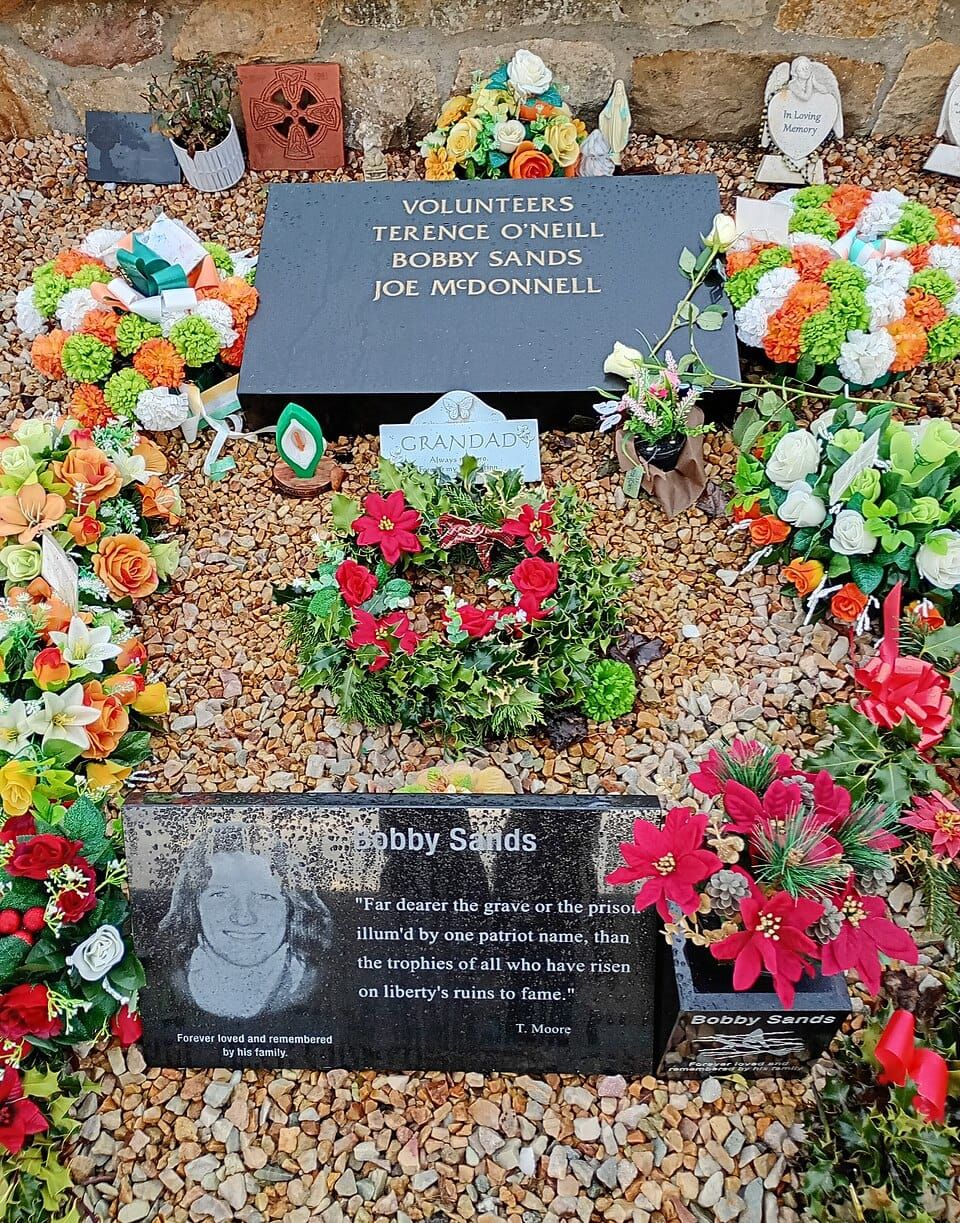
In 1980 and 1981, a group of IRA prisoners in Northern Ireland’s Long Kesh Prison, launched a strike that culminated in the death of 10 men, including Bobby Sands, who’d been elected a member of Parliament over the course of the strike. Most recently, the UK saw its largest prison hunger strike since the one that killed Sands, enacted by the prisoner collective Prisoners for Palestine, in 2025. The strikers sought an end to censorship of prisoners’ communications, as well as an end to the terrorist designation of the group Palestine Action, to which they belonged. Five of the eight strikers were hospitalized, with prison officials allegedly slow-walking medical treatment and restricting the hospitalized prisoners’ access to their lawyers. The strike began on the anniversary of the Balfour Declaration, the 1917 edict in which the British government — while imprisoning and ultimately killing Irish republicans like Ashe — announced its support for the creation of a Jewish state in Palestine.
Hunger sharpens on a visceral level. Every other sensation becomes acute. It rides on the shoulders of our irritation or exhaustion, slowly devouring the world around us. When it reaches the point of killing us, it shuts down our brains and blinds us just to keep our hearts pumping. Its power and its horror is in how it strips us layer by layer to our very barest essence, renders us abject in a way that is impossible to miss or gloss over. That display — “lenten fast,” the Troscadh, whatever you want to call it — is one of particular power when carried out in public. Play it out on a rich man’s front door, and the nature of the accusation is impossible to miss or cover over. “A stinking corpse on your doorstep?” Hilary Swank as Paul rhetorically asks in the 2004 historical drama Iron Jawed Angels. “What will the neighbors think?”
By another coincidence, this year Ramadan ends two days after St. Patrick’s Day, an occasion about which — as an Irish-American — I’ve always had mixed feelings. The holiday is the embodiment of the kind of specifically Irish-American culture that emphasizes drinking, brawling, and blasting thr the Dropkick Murphys– things Americans of all ethincic backgroundslove far more than do actual Irish people. Irish-Americans are paradoxically able to visit their ancestral homeland with much more ease than many other diasporas but can seem particularly culturally distant from it.
Part of this is due to political asymmetries. In his book “Say Nothing,” Patrick Radden Keefe describes incidents in which IRA operative Brendan Hughes grew so frustrated with right-wing Irish-Americans that he abandoned efforts to fundraise from them. Painfully, the first year of the Israeli genocide in Gaza was armed by a proudly Irish-American president — even as Ireland’s government and people took a stand against it. Yet the disconnect here also lies in the vast chasm of time between many Irish-Americans and their immigrant forebears. Irish immigration across the Atlantic saw its high point nearly two centuries ago, amid the ravages of a hunger nobody chose: the Great Famine, which followed a blight that devastated the staple potato crop.
To people who only know those basic facts, the famine is often spoken of as some sort of freak accident, a run of wildly bad luck for a people associated with good fortune. Both modern historians and contemporary sources, however, suggest that it was deliberately exacerbated by the British government, who saw a chance to kill two birds with one stone, conducting an interesting experiment in the relatively new science of laissez-faire economics on a people they viewed as expendable.
“[P]otatoes failed in like manner all over Europe; yet there was no famine save in Ireland. The British account of the matter, then, is first, a fraud; second, a blasphemy,” the Irish patriot George Mitchel wrote in 1861. “The Almighty, indeed, sent the potato blight, but the English created the famine.”
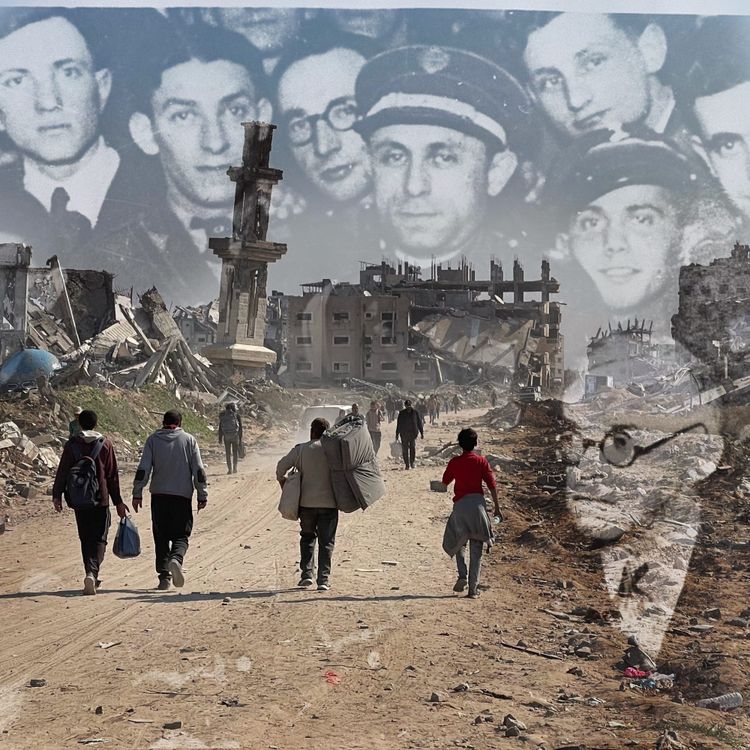
There are echoes of this passive-voice famine in the starvation of Gaza during Israel’s siege of the strip. Trucks carrying humanitarian aid and badly-needed food were turned back over the presence of ‘contraband’ items like sleeping bags with zippers; IDF forces regularly shot civilians gathered at food trucks. It makes the Ramadan fast an even more powerful expression of faith that so many people undertaking it know what it is to be deprived of food by external agents instead. What greater expression could there be than to look one of the most hideous deaths possible in the eye and, for lack of a better word, microdose it?
It’s always sort of an act of hubris to try to summarize centuries or millennia of theological jurisprudence in a few paragraphs, but ultimately, the purpose of fasting from a religious perspective, across faiths, is to bring us closer to God in some way or other. In a time when He can seem farther away than ever, that idea has particular resonance. If God is in the slums and the homeless shelters and among the wretched of the earth, perhaps we can find him in our solidarity with those who need him the most. Perhaps we can do so all the more directly when we choose hunger: in doing so, we place ourselves adjacent to those whose oppression has manifested as hunger forced upon them.
So on this St. Patrick’s Day, I didn’t have a pint — in addition to the Ramadan fast, I gave up drinking for Lent — but I will continue to think of those who wield their hunger in the absence of anything else to wield. And as we progress to Eid al-Fitr, the Islamic holiday that marks the breaking of the Ramadan fast, I will be making some small, personal gesture toward the people of Gaza and Iran, and what our nation has done to them; and toward the culture I myself come from. And I will remember Bobby Sands, who starved himself on England’s doorstep, and whose words adorn a mural today on Belfast’s Falls Road: “Our revenge will be the laughter of our children.”
Zack Budryk is an author and journalist who covers trade for MLEX. His writing has appeared in The Nation, Teen Vogue, The Hill, The Washington Post and Welcome to Hellworld. You can follow him on Bluesky at @gonebabygone.bsky.social.
This has been Heat Death. We're entirely reader-supported independent media. If you like what we do here, feel free to subscribe: paid memberships are just $2 to $5 a month, and the money goes to support writing like this. (Or you can always leave us a tip.)
While we're growing, the single most helpful thing you can do is send it to someone you think will like it or post it on your favorite social with a nice note. We are, above all, a word-of-mouth operation.
Eid Mubarak, a fine Lent and a pleasant break-fast, everybody. Until next time.


Member discussion